
From cleanliness to microbial control. Generate it where you use it...
OZOSL’s hydrolytic ozone technology, also known as the Hydrolytic O₃ Harmful Microbial Control Technology, generates pure ozone (O₃) and aqueous ozone using purified water. This highly oxidizing aqueous ozone solution is a powerful disinfectant that can safely and effectively inactivate more than 99.999% of most pathogenic bacteria and viruses within 10 to 30 seconds. After rapid sterilization, it produces ozone‑enriched water and oxygen (O₂), which are clean and leave no residue. Hydrolytic ozone technology serves as an exceptionally versatile disinfection solution, applicable in areas such as water purification, food processing, surface and object disinfection, air deodorization, as well as personal hygiene and disease prevention.
What is ozone?
The molecular formula of ozone is O₃; it is an allotrope of oxygen (O₂) and consists of three oxygen atoms. At room temperature, it exists as a pale blue gas with a faint grassy odor. Ozone is chemically highly reactive and possesses exceptionally strong oxidizing power, with a redox potential of 2.07 V—higher than that of hydrogen peroxide, hypochlorous acid, and chlorine gas—making it a widely recognized, highly effective, broad-spectrum disinfectant.
What are the ways ozone is produced?
Method 1: High-Voltage Air Discharge (Corona Discharge Ozone) This method generates ozone by subjecting air to a high-voltage electric discharge of several thousand volts (3,000–5,000 V). A drawback is that, during the electrical breakdown of oxygen, nitrogen in the air is also ionized, producing nitrogen oxides (NOx), which are carcinogenic. Consequently, the ozone produced is unsuitable for household use; this approach is predominantly employed in large-scale industrial ozone-generation systems.
Method 2: High-Pressure Ozone from a Pure Oxygen Source High-pressure corona discharge using a pure oxygen source represents an advanced variant of this technology. It generates ozone by subjecting high-purity oxygen to high-voltage ionization, with the gas feed containing no nitrogen. This approach avoids the formation of nitrogen oxides—a common drawback of air‑based ozone generation—while delivering higher ozone concentrations and greater solubility, resulting in significantly superior disinfection performance compared to air‑based ozone. However, the entire system relies on an oxygen‑generation unit, which is bulky, making it the preferred solution for municipal water treatment plants, hospitals, and large food‑processing facilities.
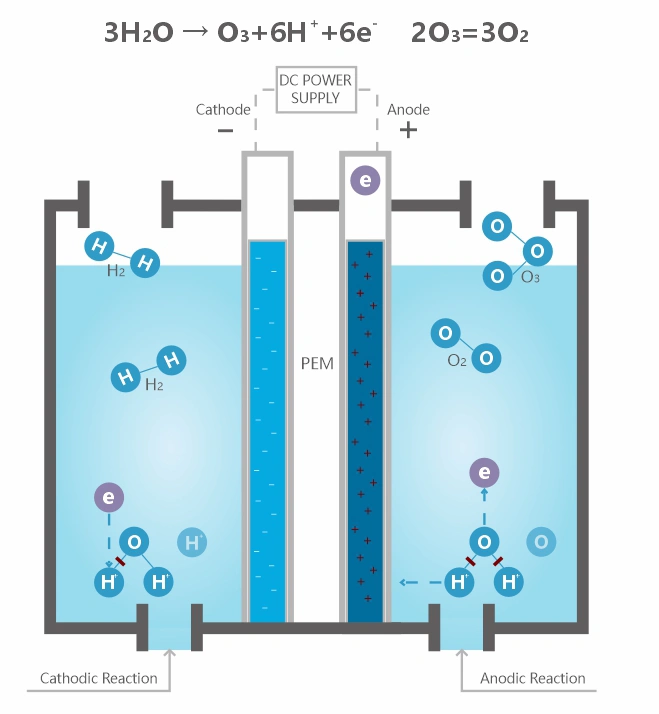
Method 3: PEM‑catalyzed ozonation (the method employed by OZOSL) Using purified water as the feedstock, the water is oxidized at a specially designed anodic interface to generate O₃, while H₂ is produced at the cathode. This device can produce high‑concentration ozone (O₃) with no harmful nitrogen oxides (NOx) in the product stream. The resulting ozone is safe and non‑toxic, meeting food‑grade and medical‑grade disinfection standards.
Method 4: Electrolysis of Water to Produce Ozone (Requires Chlorinated Tap Water) Using tap water as the feedstock, low-voltage direct current is applied to electrolyze tap water containing acids, bases, and salts. At the anode, oxidation reactions generate O₃, Cl₂, NaClO, and H₂O₂, while H₂ is produced at the cathode. However, this apparatus not only produces O₃ but also yields other harmful byproducts.
What are the advantages of OZOSL hydrolysis ozone?
Safety: Low-pressure (1–5 V) electrolysis produces pure water. Non-toxic: It generates only pure ozone, with no toxic byproducts. Environmentally friendly: The byproduct of rapid sterilization is harmless oxygen (O₂), leaving no toxic residues; it can also break down organic chemical contaminants in water and air, enhancing drinking water quality and freshening the atmosphere. High efficiency: Its sterilization efficacy is 3,000 times that of ultraviolet light, 600 times that of effective chlorine, 25 times that of medical alcohol, and 15 times that of high-temperature disinfection.
Hydrolyzed O3 developed and manufactured by OZOSL Both the generation devices and the disinfectors have been approved by the health authorities and are certified as “related to drinking water.”
“Hygiene Licensing for Sanitary Safety Products,” with categories including general water quality processors and drinking water disinfectors, among others. Furthermore, the products have been tested by the Shenzhen Institute of Metrology and Quality Inspection (SMQ) and found to comply with…
In accordance with relevant national standards, the Guangdong Provincial Microbiology Analysis and Testing Center (GT) conducted an acute inhalation toxicity test in mice, and the test concluded that the substance is essentially non‑toxic.
OZOSL, together with Germany’s TÜV SÜD and the Dr. LÖRCHER Water Quality Testing Center in Stuttgart,
Dr. Van De Loo Testing Center (Germany), Shenzhen Institute of Metrology and Quality Inspection (SMQ), Guangdong Provincial Microbiology Analysis and Testing Center (GT)
We have established long-term cooperative relationships, and our products have obtained numerous domestic and international quality and safety certifications.


Business Cooperation
Dealer Application
Apply to distribute OZOSL in Mainland China
Partner Application
Project Consultation
Product Development Consulting
Custom hydrolytic O₃ modules built to spec >
Project Collaboration
Dealer network
Distributors (incl. HK, Macao, Taiwan)
OZOSL Dealer Information Inquiry
Global Partners
© 2026 OZOSL · This site is operated at ozosl.co